
I found this puzzle at the thrift store. It’s by Areaware, called “Gradient Puzzle”, and designed by Bryan Wilner.

I love bright colors but have only done two gradient puzzles so far. I was afraid this one was going to be hard, given that there are really only two colors here. Then I read the back of the box.
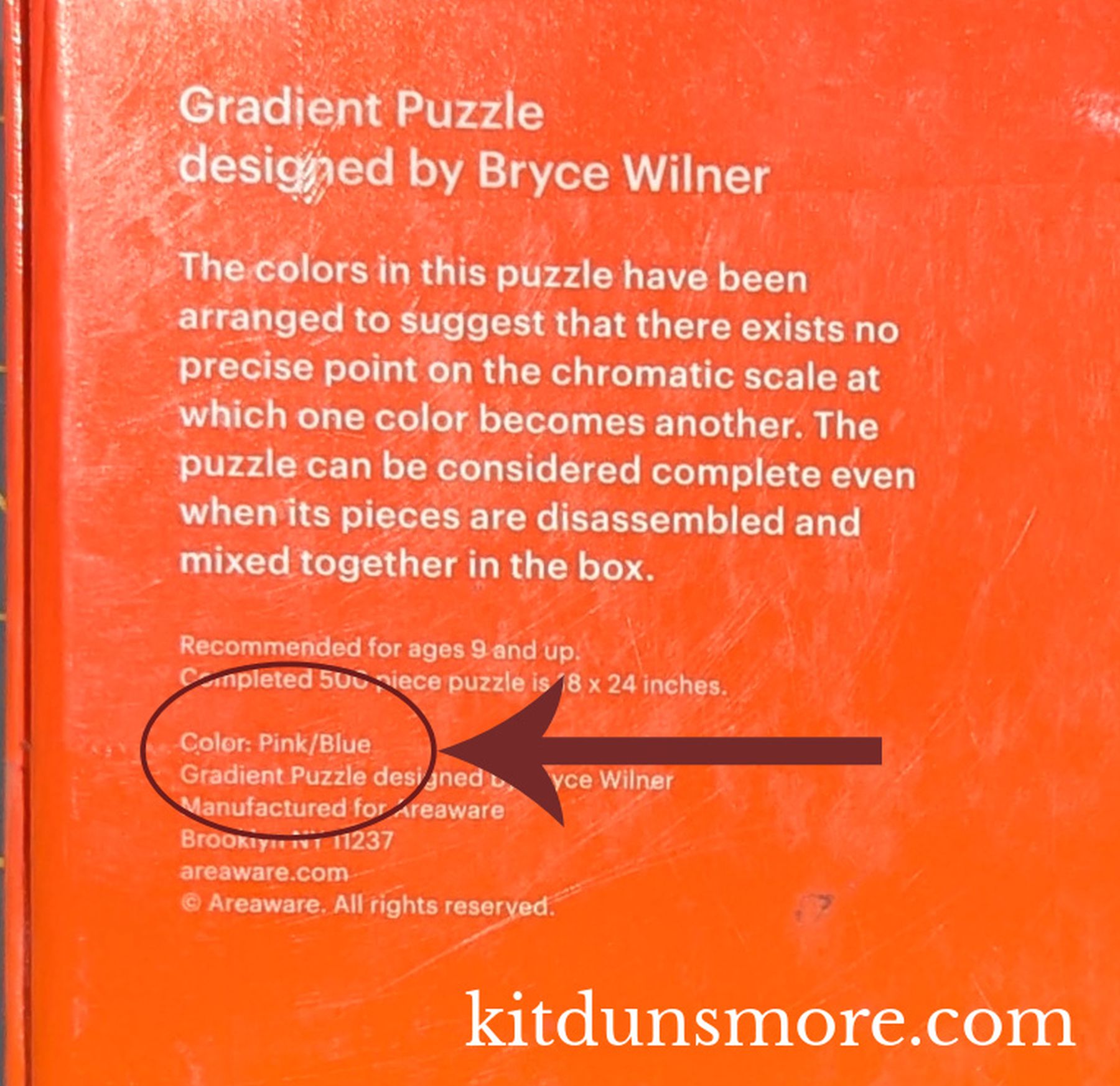
The idea that the puzzle could be considered solved even while disassembled amused me, but the thing that really caught my attention was the description of it. The color is listed as “Pink/Blue.”
All I had seen on the box was Orange/Yellow, so I examined it carefully and found a bit of pink paper taped to one end. Could it be one of those “actual product color” patches you find on items that come in multiple colors?

I couldn’t think of any reason why the box and puzzle would be different colors, so I bought it, too curious not to know. (Even if I had been cheeky enough to open the box at the store, it was so well taped that I thought it was still factory-sealed.)
When I opened the box, I found puzzle pieces ranging from bright yellow to bright orange. I shouldn’t have been surprised, but I was.

Now I want to know why the text on the box claims the puzzle is “Pink/Blue.” Also, who put the pink paper on the box, and what color were the pieces supposed to be?
The puzzle was made in China, so that probably explains everything. But I’d still love to know how this happened.
Have you ever had an unsurprising surprise?

io Kit! i don’t do many puzzles, although my family breaks one out about once or twice a year and kind of tag-teams away at it at odd hours. They choose puzzles rich in detail that are fun to work on. i chose this one, not because i expected it to be a fun one to work on, but because i go way back with this particular piece by this particular artist.
Figured i’d work from outside in, doing the hard parts first (once edges and borders were in place) and saving the figure (and signature) for last. Then on my bday did the whole figure as a matter of self-indulgence. Worked outward over the next month or two, gradually slowing down and losing interest.
As of this writing, i haven’t touched it in a couple months. Me mum added some pieces last night, all but one not quite fitting. Dunno if you can tell from this photo – all pieces have essentially the same topology, opposed innsies and outsies which i call “male doing jumping jacks,” and the cuts are so similar that often a piece will seem to fit perfectly until later surrounding pieces prove it wrong. Mom brought in a thick magnifying glass with a circular light around it so that our elderly eyeballs can look straight down into a connection to see if there’s any gap where cardboard shows through. Even then, a tight-fitting piece can still be ousted by its neighbors. Several in this photo i have since removed or replaced.
And there’s one piece of her hair, a solid true black i believe, that won’t lay flat even when gently forced. When a space in the upper third won’t seem to accommodate any other piece, i pull out that hair piece and try it; so far, naethin shakin’. If it is true black it is indistinguishable from that dark raw umber of the upper region, at least while side-by-side in our light blue sorting trays or on my ginger-honky-coloured palm. (But there’s the gradient: cool dark raw umber up top to warm light burnt sienna down below…! i’ve never had much sensitivity to colour, but working on this has deepened my appreciation of Frazetta’s use of complementary colours. At least somewhat, i hope.)
So anyway like i said i’m probably about out of steam on this. It’s set up in a low-traffic corner so no one’s bugging me to put it away yet. But i thought i’d run it by you before i break it down, in case you had any words of encouragement, discouragement, outrage or ennui…
These are the hardest parts to do, when things that are basically one color. A grid-cut puzzle with only that traditional shape (two outs, two ins across from another) makes this part even worse. However, you are an artist, so you are good at shapes and details. If you really want to finish, I suggest sorting your remaining pieces by shape, paying attention to direction. I’m not sure, but I think from your photo that your pieces are rectangular, not square. That means they run a certain direction in the puzzle and you can use the orientation in the sort to help reduce the number of pieces you have to look at. You do have to look at really specific things — how wide are the “legs” (the pieces on either side of an in)? Where is the knob? Right in the middle, more to the left, more to the right? It takes some persistence, but it can be done.
However, this is tedious puzzling in my book. I just gave up on a puzzle I was doing when I had nearly 200 pieces left and they were all black. I sorted by shape and picked away at it for a while, but I wasn’t making much progress. I decided I was no longer having fun and gave myself permission to stop. I put the puzzle back in the box. (See comment below with photo.)
Thanks! There are skinny ones and fat ones but they don’t seem to alternate or rotate consistently. Now that you say, iirc the bottom row seem to be nodding their – no it’s the TOP row (because i’m working on it upside down) so i’m going to say it’s their HEADS that are all or mostly nodding in the same direction. Think i’ll re- sort and give it one more pass. Again, thank you!
You’re welcome! I wish you success!
Here’s the puzzle I gave up on: Liberty Rainbow by Eeboo. The colored parts were fun, but the all black section was a snoozer.